The Importance of Calcium Hardness
Learn what calcium hardness tells you, why the pool finish matters and how to investigate recurring scale or an unexpectedly low result.
Calcium hardness measures the calcium dissolved in pool water. It belongs alongside pH and total alkalinity when assessing water balance. A result should be interpreted for your pool finish and equipment, not corrected to a universal number copied from another pool.
Why the finish matters
Water balance affects both the surface and equipment. Cement based finishes, fibreglass, vinyl and tiled pools can have different care requirements. New finishes may also have a specific startup programme. Keep the builder’s water care instructions with your test records and use them when setting targets.
Check that the test measures calcium hardness
Some tests measure total hardness, which can include other minerals. Confirm what your kit reports, its range and how the endpoint is read. Repeat a surprising result before buying a treatment. Record the units and take the sample after recent additions have mixed as instructed.
If the reading is low
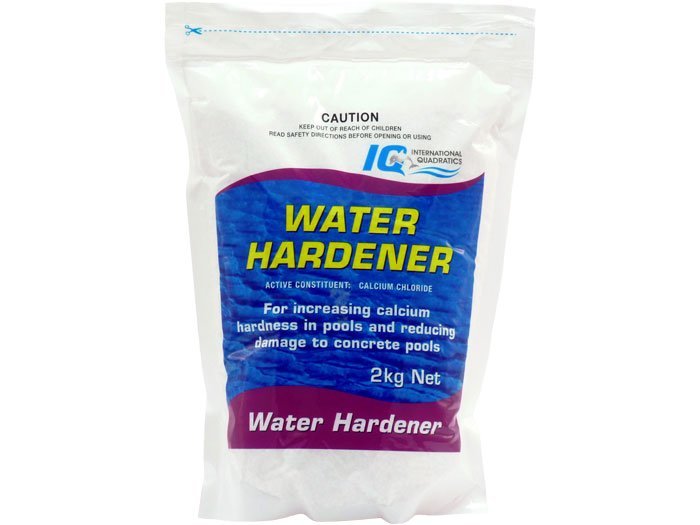
Confirm the required target and the pool volume. A pool hardness increaser commonly uses calcium chloride, but product strengths and application methods vary. Follow the actual container directions for handling, mixing, staged dosing and retesting. Do not improvise a mixing recipe or add extra to cover an uncertain volume.
If the reading is high
Look at pH, alkalinity, temperature, the source water and the treatment history together. White deposits can indicate a scale problem, but appearance alone cannot confirm the cause. A product described as scale control may help manage deposits without physically removing calcium from the water.
Before considering partial water replacement, test the refill water and arrange a safe plan. Water that is similarly hard may offer little improvement. Full draining should never be the automatic response to a test result.
Find out why it keeps changing
- Record top ups and partial water changes.
- Check which chlorine products are being used.
- Note new surface work and the builder’s startup instructions.
- Compare readings taken with the same reliable method.
Photograph recurring deposits on tiles, fittings and the chlorinator cell. Different locations may need different cleaning approaches even when they share a water balance issue.
Read our scale prevention guide and send your complete water report if you need help interpreting the result. Checking the whole balance is more useful than treating calcium hardness in isolation.
Further reading: SPASA, water balance.